In a 'nutshell.' So much of playing music is making music; get our instruments tuned up and make some noise. Doing it along with musicians is how we can draw from the magics that surround us all. In the discussions which follow are all sorts of musical ideas to jamm along with. Everything is tuned up to standard pitch, often with the same basic chords looped into the common progressions and forms that we find all through the Americana styles. So tune up, find a jamm and play on and on and on :) |
Vamps ~ jamms ~ loops. In through all the Americana vamps, loops and grooves that fill the dance floors, how fast it goes; its tempo and the beat, can make all the difference. In this first ideas we hear two versions of the same song artistically shaped by their artist's maybe wanting to fill their dancefloor. We know slowing down a tempo can genuinely deepen heartfelt testimony. So what's on the flipside ? Brighter tempos can just bring out the joyous energies of 'go for it life' itself. Compare these two versions of the same theory elements; building major triads from One and Four bass notes with similar rockin' tempos, yet each with its own unique 'feel.' Example 1.
Ah yes, the gospel power and magic of One to Four in any groove we can dream up :) Bottom line, from the blue'n easy dance-able 50's pop of the Bobby Blue Bland classic dancefloor packer to big roar rockin' music of the 'The Grateful Dead', put the same notes in different 'feels' and whoa ... lookout ... ! And if there was ever ... An Americana bass line story of a 'we got this fill the dancefloor right now', wow ! Just the two major triad pitches 'E ( E G# B) / A (A C# E)' arpeggitated, with a blue 7th added to the chords. Teach it to the band, using dynamics and assorted rhythms to stretch it out into one of your band's own jamms ( there's cool lyrics too of course :) |
|
Classic One to Four vamp ~ '2 / 5' cell ~ 'A- / D7.' In this next idea we pair a West Coast cool Latin dance riff and lyrics ... "listen to how it goes, come and enjoy it." With the now ancient Dorian pitches arpeggiated to rhythm synch with the timeless Latin poly rhythms which meets an analogue, electrified Americana guitar rig. Wow, a two chord vamp and lead guitar can sound like this. Example 1a. ~ A C E G A F# D ~
This'll jam on forever and ever; 'A-7 D7', especially with two drummers ! Ya just gotta wanna bring it. Here are the voicings. Example 1b.
No beat ever to fast or to slow, all keys, all styles, all welcome to join in and make the music go :) P.s. And with the 'F#' in this group of pitches; 'A B C D E F# G', we can bring back today riffs and melodies of the now very ancient Dorian moods of long ago :) |
|

~ and take it on the road ... ' ~ |


~ three chords / 'C, F and G / 1 4 5 in C ... ' ~ |

~ three chords / 'E minor, G and D ~
|

All good notes in 'E major.' We get our next jam track here from the song "Blue Sky", written by Dickey Betts from the Allman Brothers Band. Among the finest of songs that can be dubbed ... 'three chords and the truth', "Blue Sky" brings a joy that all musicians can aspire to learn to capture. In 'E', our jam rolls back and forth between the tonic One chord and Four, off to the dominant Five for the refrain for the song's title words. Here's the barre chord shapes and the group of pitches / scale shape for creating melodies. Bass line pitches are root to root; so 'E to A.' Pure pentatonic so all good pitches right ? Example 1.
Find and spin the recording as time permits and chances are that on your first take, you'll be hooked by the song that has now inspired a couple of generations of Americana guitarists. Do count measures in this song too, clear five bar phrase with perfect balance, kinda rare. For pro leaning melody cats, rote up on the back to back guitar solos, for there's a fluidness of art and technique we all might benefit from. Let your ears decide for ... |
|


All good notes in 'E minor.' Same basic chords again in the same key center with root pitch 'E', but in minor now. Plus we add a chord, so things evolve a bit too. With a reggae feel, here formed up in 12 bar form. Use the chord shapes to find new melody pitches, drum licks for motor hand rhythms ideas. The 'improv' shape also works well down one octave to the open strings. Author's note. Perusing through our library of songs and keeping a tally, we can see that the majority of songs are written in a major key. That said, some styles and cultures lean to the minor, so a best source for chords and progressions is from the musical art itself; songs. |
|
|

Begin jamming with bass note rhythms. These next examples provide bass notes to play your instrument with. Add chords and melodies to create a duo format. With a phone, record your session as a voice memo and listen back. These bass pitches and lines loop over and over, so just find your way in and keep it all going with rhythm. When it stops just click them again to begin a new loop. Recording helps us remember the good ideas we find and how do we like the music we are making while remembering; 'if it sounds good, it is good' and that 'all music was once new.' |
For guitar, these folk chord shapes have been with us for a couple of hundred years now, some even go back to the lute, so they're in a million tunes now, do try to learn them all here and now if need be. Surely they can get you started. That these 'open' shapes all become some sort of a movable barre chords is the kaboom here. Fingerings change but the shape of the core arpeggios within remain. Barre chords get us moving up the neck without a capo, easing key changes and modulation along the way of an arrangement. |
|
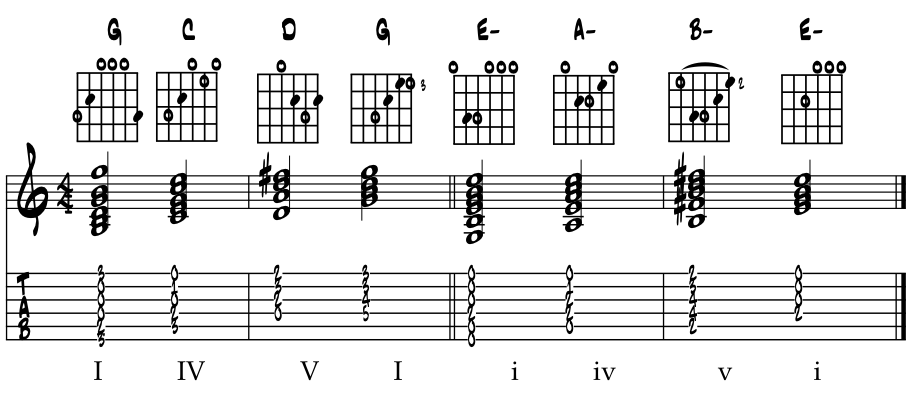
'Add 7' to a triad and we 'giant step' to a the next level and begin to morph more of the available colors together and thus, surely moving us into the realms of blues and jazz and 'jazz up' whatever might come along in need of a bit of 'jazzing up.' Cool ? Open chord shapes in 'G / Em.' Example 5. |
 |
'by ear ...' |
C A- ( 1 to 6 ) |
 |
A- D- E- ( 1 4 5 ) |
|
C to F ( 1 to 4 ) |
|
A- D- ( 1 to 4 ) |
|
C F G ( 1 4 5 ) |
|
C D- E- F ( 1 2 3 4 ) |
|
A- C F E- ( 1 3 6 5 ) |
|
C E- F G ( 1 3 4 5 ) |
|
F G A- ( 6 7 1 ) |
|
A7 D7 ( 1 to 4 ) |
|
C- Bb Ab G ( 8 b7 B6 5 ) |
|
D- G C A- ( 2 5 1 6 ) |
|
Find a fave ? Cool. Now what ? Can you spell out the letter names of all of the triads included above ? |
Jammin' with Franz and chords. The following soloing / jam with band vamps are generated with Franz being the motor. While not heard in the mix, know that there's clicks driving these rhythms and chords into mainly four bar vamps. Find the pitches and chords 'by ear', and even teach one or a few of the vamps you dig to your own peeps and bandmates, and commence the jammin of your own creative collabs into your own original songs. |
'Round about that time ... ' loop first note is 'A' |
|
|
|
||
E- / D / C / B- |
|
|
|
||
"Feeling Alright" ... |
|
|
... just catchin' a wave ... C- Bb Ab G |
|
|
2 5 1 6 2 5 1 6 2 5 1 6 2 5 1 2 5 1 6 ... :) D- G C A- |
|


Montuno. From South of the Equator comes the mountains of montuno riffs that energize the Latin songs and their dances. And while there dozens of riff of melodies and chords and rhythms, there's a couple of super cool and common montunos that work like everytime we need an intro, vamp for a tune, something to jamm on, interlude between sections, so a lot of places in our music to 'bring the montuno', 'bring a mountain.' |
|
D- G7 |
|
||
C pedal |
|
||
F to Gb |
|
||
F to Gb7 |
|
most common ? |
|
A-7 D9 |
|


Review. Jamm loops are where we all get to at some point to move our music ahead. They can range from jammin' with the radio to selected songs, to just the clicks of a metronome to motorize time for our imagination to completely conjure. All good; time is essential in the jamm, developing an instinct for looping four bar phrase, building through the color tones to a climax, finding a beat and rhythm to syncopate, |
"The key to the future of the world is finding the optimistic stories and ... letting them be known." |
References. References for this page come from the included bibliography from formal music schools and the bandstand, made way easier by the folks along the way. In addition, books of classical literature; from Homer, Stendahl and Ladurie to Rand, Walker and Morrison and of today, provided additional life puzzle pieces to the musical ones, to shape the 'art' page and discussions of this book. Special thanks to PSUC musicology professor Dr. Y. Guibbory, who 40 years ago provided the initial insights of weaving the history of all the fine arts into one colossal story telling of the evolution of AmerAfroAsiaEuroLatin musical arts. And to teacher-ed training master, Dr. Joyce Honeychurch of UAA, whose new ideas of modern education have hopefully come to life in this e-book. |
"Life is about creating yourself." |
wiki ~ Bob Dylan |
Find an e-book mentor. Always good to have a mentor when learning about things new to us. And with music and its magics, nice to have a friend or two ask questions and collaborate with. Seek and ye shall find. Local high schools, libraries, friends and family, musicians in your home town ... just ask around, someone will know someone who knows someone about music who can help you with your studies of the musical arts with this e-book. |
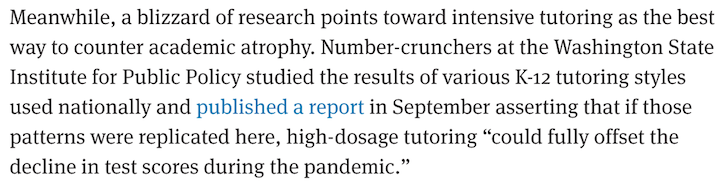
Intensive tutoring. Luckily for musical artists like us, the learning dip of the 'covid years' can vanish quickly with intensive tutoring. For all disciplines; including all the sciences and the 'hands on' trade schools, that with tutoring, learning blossoms to 'catch us up.' In music ? The 'theory' of making musical art is built with just the 12 unique pitches, so easy to master with mentorship. And in 'practice ?' Luckily old school, the foundation that 'all responsibility for self betterment is ours alone.' Which in music, and same for all the arts, means to do what we really love to do ... to make music :) |
 |
"These books, and your capacity to understand them, are just the same in all places. Always bear in mind that your own resolution to succeed, is more important than any other one thing." |
|
Academia references of Alaska. And when you need university level answers to your questions and musings, and especially if you are considering a career in music and looking to continue your formal studies, begin to e-reach out to the Alaska University Music Campus communities and begin a dialogue with some of Alaska's finest resident maestros ! |
|
Formal academia references near your home. Let your fingers do the clicking to search and find the formal music academies in your own locale. |
"Who is responsible for your education ... ? |
'We energize our learning in life through natural curiosity and exploration, and in doing so, create our own pathways of discovery.' Comments or questions ? |
Coda. Here's a few piano keys to help you sort out the pitches that become your melodies. |
|